From WhatsApp orders to a full digital commerce experience
A Colombian artisan bakery was managing all its orders through WhatsApp and Instagram direct messages. We designed a complete e-commerce platform that brought clarity, trust, and structure to a non-traditional weekly pre-order model.

CHALLENGE AND SOLUTION
From scattered DMs to a seamless ordering experience.
El Hormiguero is a Colombian artisan bakery that operates on a weekly pre-order model — baking in small batches, 1 to 2 times per week, with a rotating menu and limited production capacity. Every single order was managed manually through Instagram DMs.
This created friction on both sides: customers didn't know what was available, didn't understand how the ordering process worked, and depended on social media stories that disappeared in 24 hours. The owner faced repetitive questions, difficulty tracking demand, and no real visibility into what was coming each week.
The challenge wasn't just to build a website. It was to design a digital system that could communicate scarcity, build trust, and simplify a non-traditional business model — without losing the warmth and authenticity of the brand.
Our answer was a customer-facing e-commerce platform built around the pre-order experience. We designed clear weekly availability windows, transparent product pages with ingredients and real photography, a streamlined checkout flow, and an order confirmation system — all structured to reduce the uncertainty that was costing the business conversions and costing customers their orders.
METHODOLOGY AND TOOLS
Research-driven design from the ground up.
We started with a deep research phase before touching any screen. The process included user interviews with existing customers, a stakeholder interview with the bakery owner, and a 26-respondent quantitative survey to validate behavioral patterns. AI-assisted analysis supported our synthesis, helping identify recurring pain points and prioritize features.
Key findings shaped every design decision:
96.2% of respondents wanted clear pricing and product information
92.3% needed real product photography to feel confident purchasing
88.5% valued order status notifications
84.6% were comfortable paying online, with a strong preference for local methods like Nequi and Daviplata
84.6% wanted to see live product availability
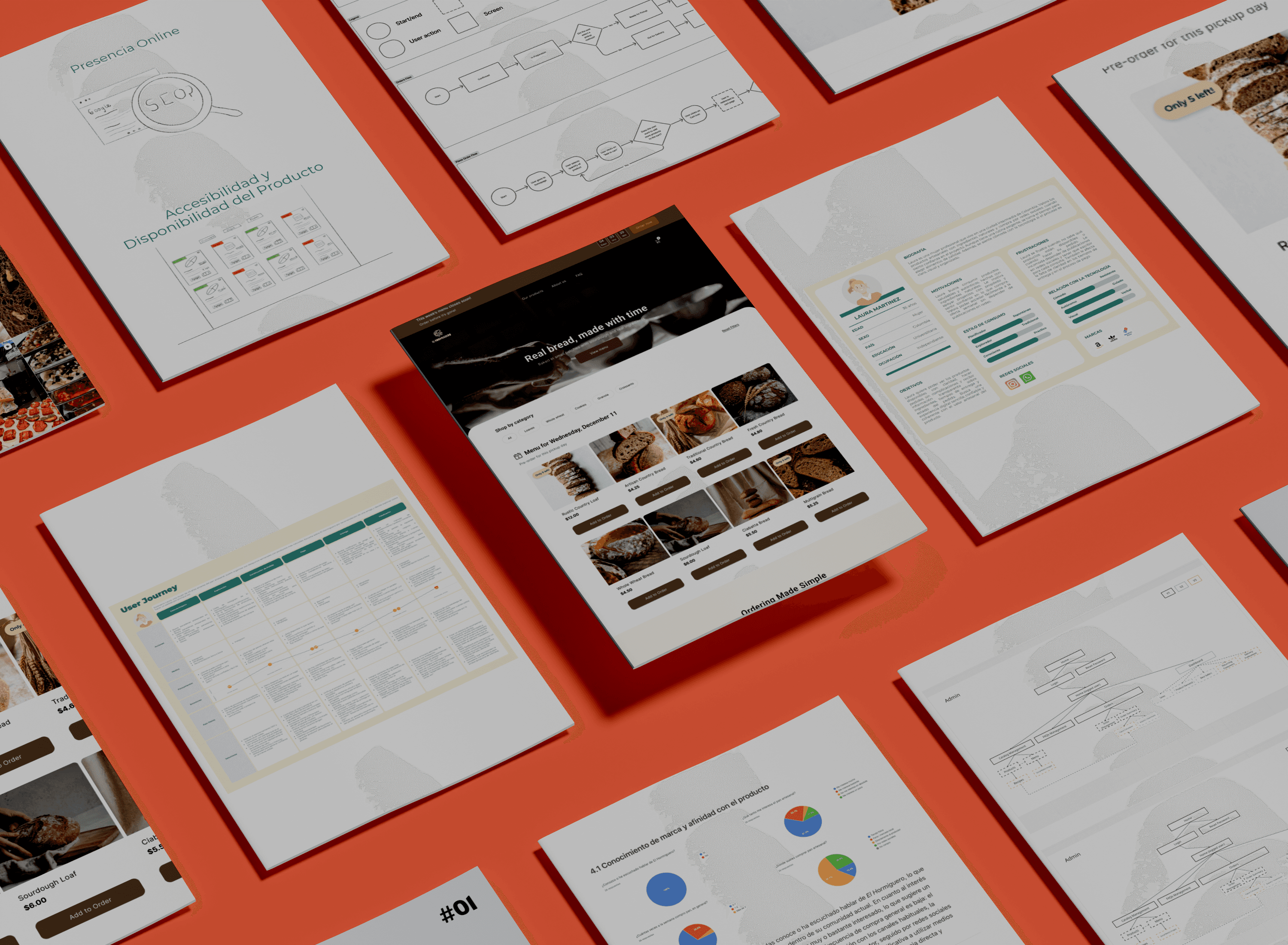
From research, we moved to information architecture, sketched wireframes in Procreate, built mid and high-fidelity designs in Figma, and validated with usability testing through Useberry.
Tools used:
Figma, for wireframing, UI design, and interactive prototyping
Useberry, for remote usability testing and heatmap validation
Procreate, for early-stage sketching and ideation
Miro, for information architecture mapping
AI-assisted workflows, for proto-persona development and behavioral pattern analysis
RESULTS
The numbers that validate the design.
Usability testing revealed an 80% task completion rate across core flows — from browsing the weekly menu to placing a pre-order — with heatmap data confirming that users navigated product pages in the expected hierarchy and engaged with the availability and checkout sections without confusion.
The platform replaced a fully manual Instagram-based system with a structured digital experience that:
Eliminated order chaos by centralizing all orders into a single trackable flow
Reduced repetitive customer questions through clear product pages, availability states, and automated order confirmations
Built buying confidence through transparent pricing, ingredient information, and real product photography
Designed for scalability — the system was built to handle rotating weekly menus without requiring the owner to rebuild the experience each cycle
How we think
At Aluna Labs, we believe good design isn't just about what looks right — it's about what works for the business and the people using it. In this project, we went beyond aesthetics to understand a non-traditional operational model and translate it into a digital experience that was clear, trustworthy, and built to grow.
We are driven by our obsession with the problem before the solution. Because for us, it was never about building a bakery website — it was about giving a small artisan business the digital infrastructure it deserved, designed around how it actually operates, not how e-commerce is supposed to work.